Clearing the Slope
Thoughts on the Difference Between Removing Invasives and Ecological Restoration
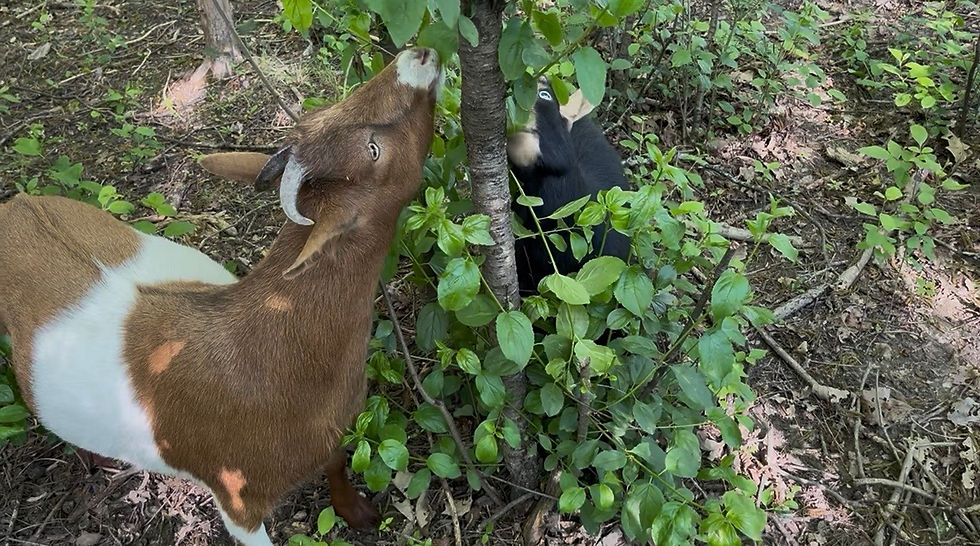
Every few days I walk the goats back to a hillside we cleared the previous winter. (For those of you who know what a real hill looks like, it’s really more of a mild slope.) As we arrive, the goats pick up their pace, trotting forward as if to greet the hundreds of fresh buckthorn shoots like old friends. While the goats browse, I wander slowly through the clearing looking for something much harder to find. A spicebush. A witch hazel. Occasionally, if I’m lucky, a young oak.
I am always curious to see what will start growing after we cut back the invasive plants in an area and let sunlight reach the ground again. When I find one of these native shrubs, I kneel down for a closer look before surrounding it with a simple cage of wire fencing. The cage is there to protect the plant from the deer, who would happily browse these small sprouts before they have the chance to get established.
Some days I don’t find anything new. Other days I do. The work rewards slow attention. You begin to notice things that were not there a week ago.

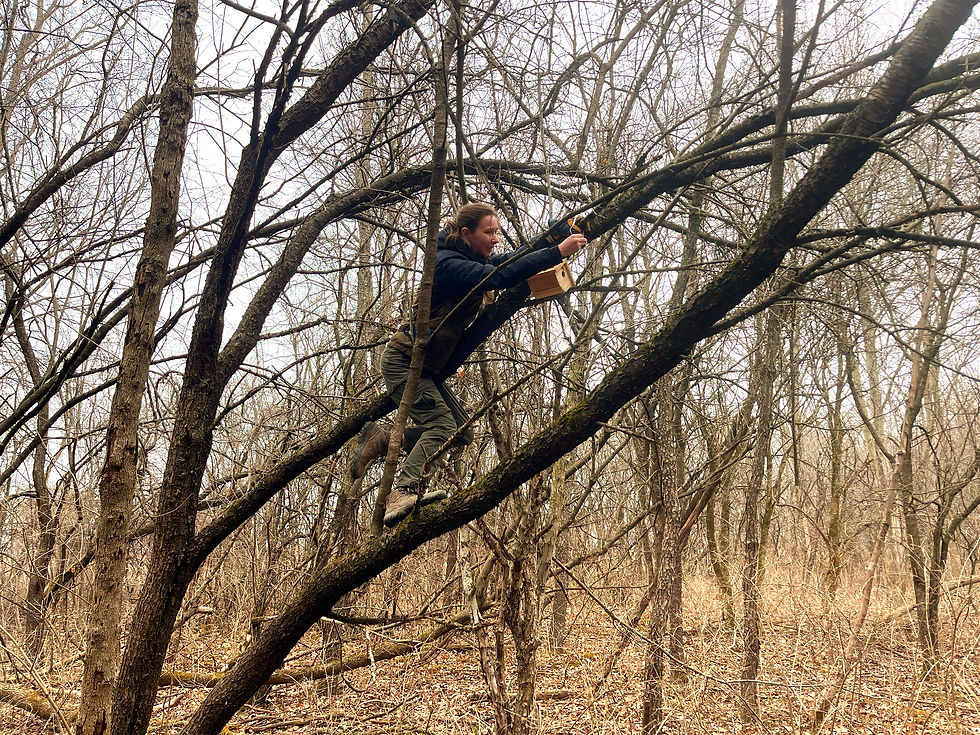
Last winter this slope was crowded with mature buckthorn, acting as understory trees rather than shrubs, and growing so tightly together they held one another upright. The work to remove buckthorn of that stature is slow and very physical. You can’t simply cut the base of the tree, shout “timber”, and be done with it. A branch caught beneath another branch can leave you wrestling with the same dangling tangle for fifteen minutes. The branches lean on one another, creating layers of tension that need to be released with care to prevent the trapped saw blades and kickback. Sometimes the easiest way to remove one tree is to cut three others first. You find yourself stepping back repeatedly, trying to understand how dozens of stems have grown together over decades, many of them thicker than my arm. Cutting them is a physics puzzle that requires patience, no small amount of spatial reasoning, and a touch of risk.
By the end of each day my forearms tremble from sawing, dragging brush, stacking trunks, and wrenching branches apart.
Every so often someone straightens up, wipes the sweat from their face—even in the middle of winter—and announces, “I hate buckthorn!”

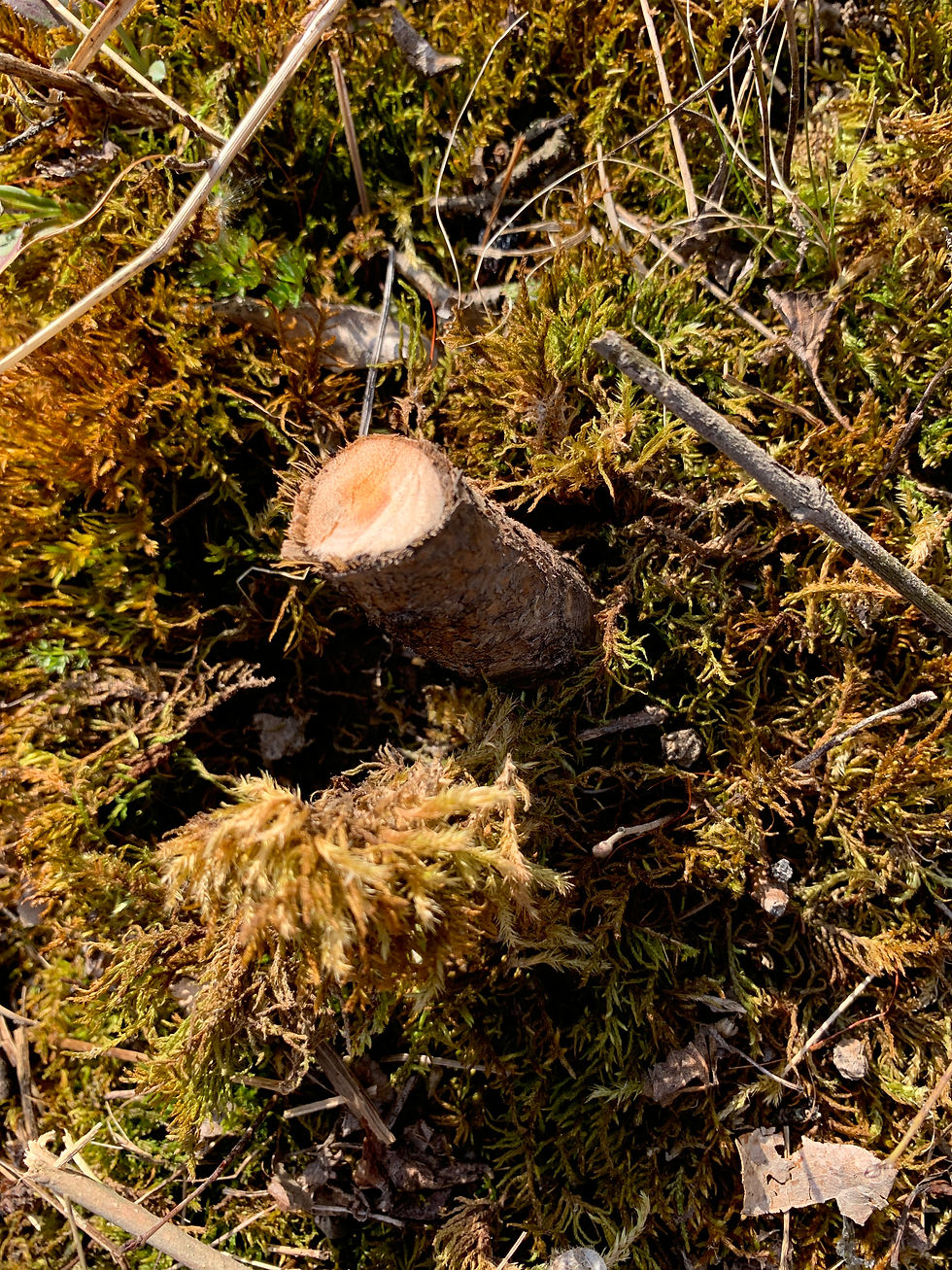
The scratches on our arms, the aching backs, the endless brush piles. Their gnarly branches don’t fit easily into the narrow opening on our little wood chipper, so dead hedges now mark the edge of the woods because there is just too much to compost. We thought the work in this area might take a couple of weeks. It stretched into months.

One volunteer had a t-shirt that read: “Buckthorn: Because every fairy tale needs a villain.”
Looking at the field now, it is clear our winter work made an impact, but by mid-July it is just as obvious buckthorn hasn’t given up the fight and has many soldiers ready and willing to retake the field. Countless seedlings exploiting the newfound sun and hundreds of bright green shoots emerging from the stumps we cut only months before. The goats may see it as breakfast, but most people who work with it describe buckthorn as a formidable and persistent enemy. Is that language exaggerated?
If the woodland is going to recover, then surely this buckthorn villain needs to go. We have to fight the invasive. Beat them back. Show them whose boss. Root them out. Vanquish our enemy. That’s how we get the job done, right?
Meeting Buckthorn

Before we go any further, I should introduce the plant we’ve cast as villain. “Buckthorn” is not the name of a single species. It refers to a large group of shrubs and small trees found around the world, including several that are native to North America. At Fellowfield, however, we are removing just two members of that group: common buckthorn (Rhamnus cathartica) and glossy buckthorn (Frangula alnus), who are both relatively new arrivals to North America.
Common buckthorn originates in the hedgerows of England and France through the temperate forests of Germany, Poland, and Ukraine into western Russia. Glossy buckthorn occupies much of the same territory, extending further into parts of western Asia and North Africa. Across their native landscapes, both species exist within forest communities that have been developing together since the end of the last Ice Age. More than thirty specialized insect species feed on or develop within these two species of buckthorn during their life cycle, including the well-studied brimstone butterfly, which lays its eggs on buckthorn leaves. A variety of fungi impact buckthorn throughout its life. The roe deer and European hare browse young shoots. Eurasian songbirds, such as blackbirds and thrushes, eat the berries before dispersing the seeds into woodlands that are well-populated with other shrubs like hazel, spindle, dogwood, and guelder rose. In that community, buckthorn has its place, but it doesn’t take center stage. Competition, herbivory, pathogens, and thousands of years of coevolution all shape the role buckthorn plays.
Here in southeast Michigan, common and glossy buckthorn are classified as invasive species. They grow quickly, in thick stands along roads, field edges, and in the forest understory. Once you learn to recognize their dark bark, rounded leaves, and black berries, you begin seeing them almost everywhere.
What Buckthorn Does to a Forest
Buckthorn really does change a North American forest.
If you walk into a healthy Michigan woodland in early April, before the trees overhead do not yet have leaves. For a few precious weeks, spring wildflowers race to bloom before the canopy closes above them. Trout lilies, spring beauties, Dutchman’s breeches. These are plants evolved to make the most of this brief window of light.
Enter buckthorn and the whole scene changes.
Buckthorn leaf out earlier in the spring and hold their leaves long after many native plants have dropped theirs in the fall. That extended season gives buckthorn more time to capture sunlight, and the ground under their canopy becomes a cool, dark, damp habitat. Over time, dense stands cast enough shade that those spring flowers disappear entirely, and fewer young trees and native shrubs survive in their company.

The forest floor begins to change. The rich layer of slowly accumulating leaf litter that used to shelter insects, fungi, salamanders, and countless other small organisms becomes thinner, and the soil community shifts along with it. Buckthorn leaves decompose unusually quickly, releasing nutrients more rapidly and favoring the microbes and earthworms that thrive under these new conditions. Even after buckthorn is removed, changes to the soil can linger for years.
Some birds readily eat buckthorn berries, spreading the seeds long distances. As more buckthorn becomes established, what was once a varied community becomes increasingly dominated by a single species over a larger and larger area.
Restoration is our attempt to interrupt that process.
When we cut buckthorn, we’re not trying to erase every individual plant from the landscape. We’re trying to change the balance of the community. We look forward to helping plants like viburnums, ninebark, and winterberry, have a chance to reestablish because these plants and many more grow together and support a more diverse ecosystem. They provide space and light for early spring flowers and their pollinators, nesting sites for birds, food for local insects, shelter for mammals, and good conditions for the next generation to thrive. We want a woodland where no single species overwhelms the others. It’s a healthier forest.
When Buckthorn was a Good Idea
Given what we know about the harm buckthorn does in North America, it may surprise you to know common buckthorn was once promoted as an excellent hedge plant.
Its introduction was not by accident or by birds. Historical records indicate it originally entered the continent for medicinal use - its berries act as a potent laxative and it was thought to be good for digestion. But during the 19th century, horticulture in the Americas bloomed and many introduced plants were cultivated as ornamentals. If you wandered into a Michigan nursery between the 1880’s and 1940’s looking for a hardy shrub to plant around your farm or home, there’s a good chance someone would have recommended buckthorn.
Nursery catalogs of the time praise its dense branching, rapid growth, winter tolerance, and ability to thrive where other shrubs struggle. Landscape designers recommended it for defining property boundaries, sheltering livestock from winter winds, creating attractive ornamental plantings, and supporting the suppression of weeds. Agricultural newspapers promoted it as an economical choice, tolerant of repeated clipping and pest-resistant.
In an era when Americans were deliberately reshaping the landscape to reflect European ideas of beauty and utility, buckthorn supported a desired aesthetic and seemed to offer practical solutions to practical problems. County fairs across the Midwest reinforced those same values by awarding prizes for the best hedge, best farm improvement, and best ornamental plantings. Order, productivity, and visible improvement were not simply personal preferences; they were public ideals.
Buckthorn fit comfortably as a hero within that story.
The Slow Switch
America’s popular shrub did not fall from favor overnight. The first questions about its value arose for agricultural reasons rather than ecological ones. In 1918, researchers learned that common buckthorn served as an alternate host for crown rust, a fungal disease that reduced oat yields. A plant celebrated for offering so many benefits was now the source of a serious problem.
At that time, buckthorn’s reputation began to slowly shift in agricultural circles, but there is evidence that nurseries and government agencies continued to promote buckthorn well into the 1930’s.
Over the decades that followed, foresters and ecologists began looking beyond farms and fence rows into woodlands. They documented the loss of diversity and changes in forest structure. The more scientists studied forests as interconnected communities, the more the cultural narrative about buckthorn shifted to emphasize its destructive role.
Today, that shift is reflected almost everywhere that people seek guidance about the plant. The Michigan Department of Natural Resources describes common buckthorn as an invasive shrub that “crowds out native shrubs and understory plants” and spreads rapidly through seeds carried by birds. Closer to home, Washtenaw County’s conservation and land stewardship organizations devote entire sections of their websites and management plans to controlling buckthorn and other invasive shrubs. Their concern is no longer whether the plant makes an effective hedge, but how dense buckthorn thickets prevent native species from regenerating, alter forest conditions, and require years of restoration work to reverse.

By the end of the twentieth century, the same plant that had once been promoted in nursery catalogs became one of the most widely recognized invasive species in North America. Today, the transformation is so complete that Michigan has added both common and glossy buckthorn to its restricted invasive species list, so beginning January 1, 2028, it will be unlawful to introduce, import, sell, possess with intent to distribute, or intentionally propagate either species in Michigan.
This is a remarkable reversal. Buckthorn’s history in the North American landscape reminds me of Hugh Grant’s acting career. In the early years, typecast as the charming hero, and now flourishing as the villain we love to hate.
Beyond Heroes and Villains
You could argue buckthorn earned both reputations, and yet, buckthorn itself did not change. Whether buckthorn is cast as a hero or villain is a cultural choice. In fact, it is a cultural choice to label buckthorn in this way at all. Doing so is one expression of a broader way of making sense of the world—a way that encourages us to divide life into opposing sides rather than attending to the more complex relationships that give rise to the situations we face.
Casting buckthorn as the villain can tempt us to believe that buckthorn is the essential problem—and that removing the shrub is equivalent to repairing the harm it has caused. But healthy forests are not restored simply by eliminating one species.
More importantly, casting buckthorn as the villain can make it easier to overlook the larger cultural patterns that are still shaping landscapes today. The worldview that once welcomed buckthorn has not simply disappeared. We still talk in terms of “vacant land” and “making land improvements”. We still reward landscapes that are orderly, efficient, and immediately productive. We replace natural wetlands with constructed ones, cut forests for parking lots, and measure success over years instead of generations. Climate change, biodiversity loss, polluted waterways, declining soils, and increasingly destructive floods are not separate stories. These are all evidence that many of the old assumptions guiding our relationship with land remain very much with us.
Buckthorn is not the cause of those problems. Nor is it merely a symbol of them. Buckthorn is one visible participant within a much larger story. A story that we are a part of as well. Paying attention to that larger story doesn’t make buckthorn less important, it makes restoration more honest.
That is why the language of heroes and villains ultimately falls short. It encourages us to look for a single savior or culprit when the deeper challenge is learning to see the cultural context and our own place within it. Restoration asks more of us than defeating an enemy. It asks us to understand and address the systems that have created and perpetuate the situations we face.
Practicing Attention
So in practical terms, what does it look like to step away from the hero-villain narrative and practice the kind of restoration I’m talking about?
Let me give you an example. At the park, there is a stretch of meadow where we started restoration a few years ago. This summer, some patches are thick with black-eyed Susan, Joe Pye weed, and cardinal flower, bright enough to catch your eye from across the field. A few steps away, the ground is dense with grasses pushing up through clay soil. In one spot, a cluster of bracken fern appeared where we never planted it. In another, almost nothing seems to be growing at all.
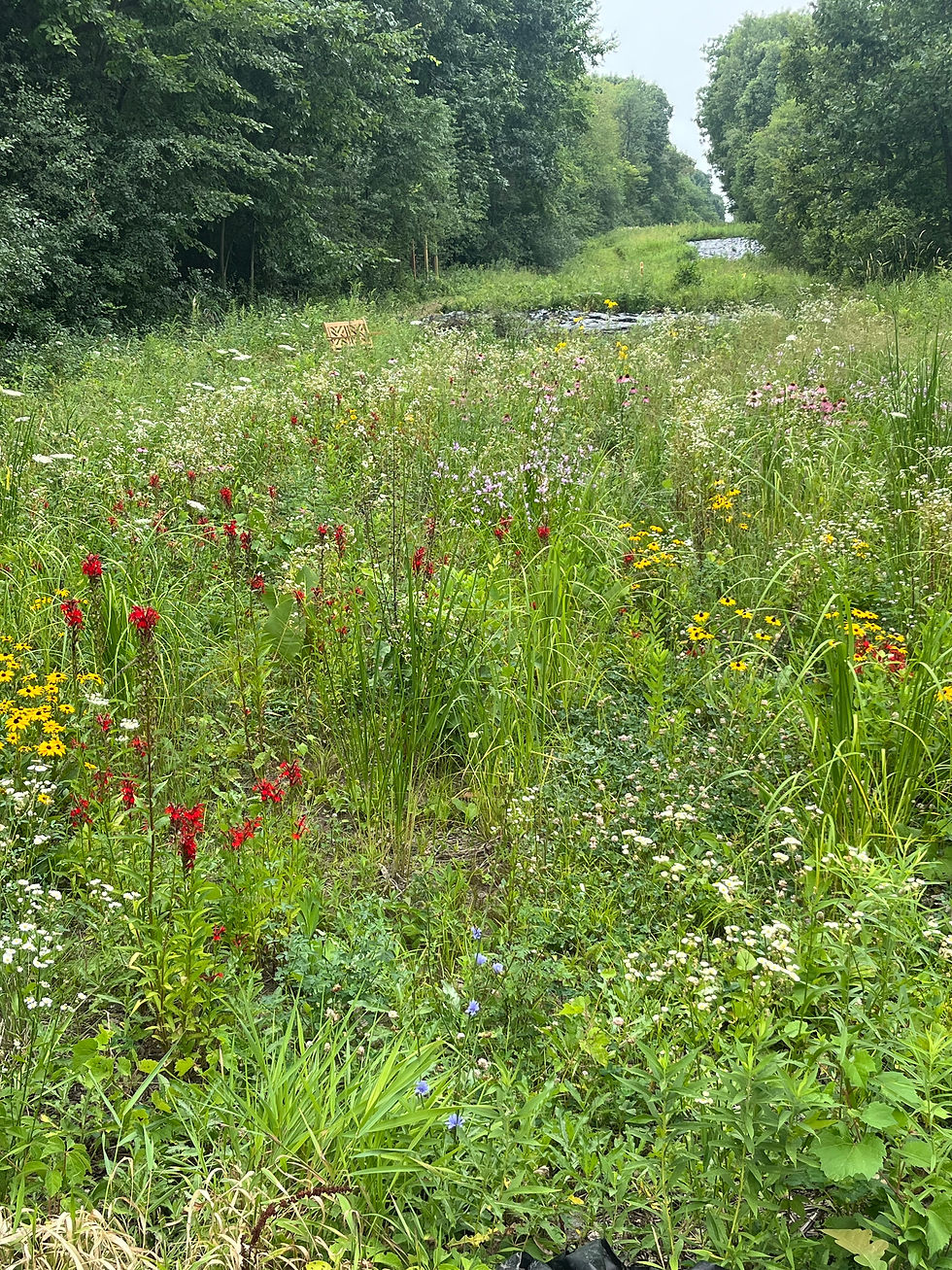
From a distance, it looks uneven, unfinished. Someone who prefers tidy landscapes might feel the urge to reseed the thin areas or straighten the edges. But that isn’t the goal. This land has lived through decades of extractive agriculture. The soil was compacted. Wetlands were drained. A handful of species, like smooth brome and Canada thistle, came to dominate in this spot. Our work has been to begin rebuilding the relationships that make a healthier meadow possible, knowing that no planting plan can fully predict how those relationships will unfold.
And I’ve discovered something interesting through this work. It is easy to take action that I believe will help the land, like cutting buckthorn or pulling thistles and planting coneflowers in their place. It may be physically demanding, but emotionally it is straightforward. What takes real effort is letting the land respond in its own way and at its own pace.
I think that’s because the habits of thought that harmed this landscape also live within me. I carry assumptions about what progress and beauty should look like, how quickly change ought to happen, and what constitutes success. Because of this, practicing restoration means resisting the urge to judge the meadow by my imagined vision of what it should be. It means staying curious to what happens, noticing what returns, digging deeper into why one native flourishes while another struggles, and responding respectfully and accepting that recovery doesn’t proceed in straight lines or have a finished destination.
How Did This Come To Be?
Over time, I began to recognize that the way we approach restoration at Fellowfield is also the way we approach education. We don’t begin by trying to provide explanations or prescribe clean solutions. Instead, we ask: How did this come to be?
When we ask that question of a patch of buckthorn, it leads almost immediately to more questions. What grew here before and how was it lost? Why does buckthorn grow so well on this slope? How have the soil and water responded to its presence? What other life lives with it now? What have humans done here? The more carefully we follow those questions, the harder it becomes to imagine that any one species, event, or person could fully explain what we see.
Instead of beginning with certainty, we begin with a question that interrupts the story we’ve already started telling ourselves. “How did this come to be?” invites us to stay with this particular slope long enough for the place itself to complicate our assumptions.
If you visit Fellowfield, I won’t try to convince you to have a more sympathetic opinion of buckthorn. In fact, I hope you’ll leave with a better understanding of why we cut it. What I hope changes is the habit of mind you bring to it— and to any complicated problem you encounter. Because buckthorn is just one example, one opportunity to practice resisting the labels that end our curiosity.
Beginning with What Is
I’ve spent enough years wishing parts of my past had unfolded differently to know that wishing has never restored anything. What has brought healing, instead, has been learning to begin with the world as it is—to pay attention, to care for what is here, and to discover the relationships that are possible.
Every act of restoration begins by accepting that history cannot be undone.
We cannot restore this woodland by pretending buckthorn was never introduced. The roots remain. The altered soils. The decisions made by farmers, engineers, conservationists, and landowners over generations remain woven into this place.
The same is true beyond this slope.
We cannot build healthier communities by pretending Indigenous peoples are “a thing of the past”, asserting that slavery wasn’t that bad, or forgetting that women, laborers, and countless others have had to organize to be heard. The past helps to explain our lives today and ignoring that history doesn’t make it disappear. It only makes it harder to appreciate and respond to the landscape we now have.
Perhaps that is why it makes a difference to see the world as a place of complex relationships rather than a battle between good and evil. The language of villains narrows our focus. It aims our attention on defeating an enemy and imagining how much better the world would be without it. The language of relationships widens our attention, and in doing so helps us discover the many and ever evolving ways we can participate in life.
Tomorrow I will walk up the slope with the goats, and I will bring a pair of loppers because, in my considered judgment, this place has more than a healthy amount of buckthorn. But that is not the only action I will take. I’ll also keep my eye out for what else is growing, and I will do what I can to protect the spicebush, the winterberry, and many other sprouts that are rebuilding something new.
References
Bailey, L. H. (1902). Cyclopedia of American horticulture (Vol. 4). The Macmillan Company.
Knapp, L. P., Coyle, D. R., Dey, D. C., Fraser, J. S., Hutchinson, T., Jenkins, M. A., Kers, C. C., Knapp, B. O., Maddox, D., Pinchot, C., & Wang, G. G. (2023). Invasive plant management in eastern North American forests: A systematic review. Forest Ecology and Management, 550, Article 121517. https://doi.org/10.1016/j.foreco.2023.121517
Knight, K.S., Kurylo, J.S., Endress, A.G., Stewart, J. R., & Reicht,P.B. (2007.) Ecology and ecosystem impacts of common buckthorn (Rhamnus cathartica): a review. Biological Invasions 9, 925–937. https://doi.org/10.1007/s10530-007-9091-3
Kurylo, J., & Endress, A. G. (2012). Rhamnus cathartica: Notes on its Early History in North America. Northeastern Naturalist, 19(4), 601–610. http://www.jstor.org/stable/41810145
Michigan Department of Natural Resources. (2024). Invasive species: Common buckthorn (Rhamnus cathartica) and glossy buckthorn (Frangula alnus). https://www.michigan.gov/invasives
Michigan Commission of Agriculture and Rural Development. (2026, May 20). Invasive species order: Amendment No. 1 of 2026. Michigan Department of Agriculture and Rural Development.
Washtenaw County Conservation District. (2026). Invasive species: Awareness, identification, prevention, and control. https://washtenawcd.org/residents/invasive-species
Webster, C. R., Dickinson, Y. L., Burton, J. I., Frelich, L. E., Jenkins, M. A., Kern, C. C. & Walters, M. B. (2018). Promoting and maintaining diversity in contemporary hardwood forests: Confronting contemporary drivers of change and the loss of ecological memory. Forest Ecology and Management, 421, 98–108. https://doi.org/10.1016/j.foreco.2018.01.010
Zouhar, Kris. 2011. Rhamnus cathartica, R. davurica; common buckthorn, Dahurian buckthorn. In: Fire Effects Information System. U.S. Department of Agriculture, Forest Service, Rocky Mountain Research Station, Fire Sciences Laboratory. https://research.fs.usda.gov/feis/species-reviews/rhaspp

Me pareció muy interesante este artículo porque explica la información de una manera clara y fácil de entender. Estaba buscando información sobre loteria nacional y encontré aquí detalles bastante útiles. La explicación resulta práctica para los lectores que desean conocer mejor el tema y mantenerse informados sobre las novedades de la lotería.